
This article may contain affiliate links. If you click a link and make a qualifying purchase, we may earn a commission — at no extra cost to you. We participate in affiliate programs including ShareASale, CJ Affiliate, and Impact. Full disclosure →
U.S. Treasury Takes First Major Step Toward Stablecoin Regulation
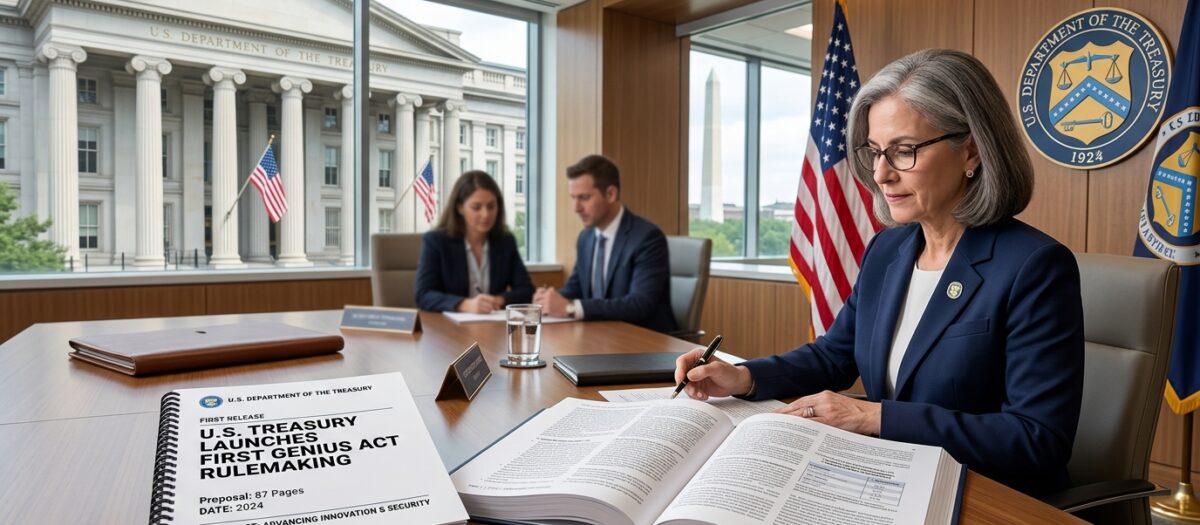
The U.S. Department of the Treasury officially kicks off the rulemaking process for the GENIUS Act (Guiding and Establishing National Innovation for U.S. Stablecoins), marking a pivotal moment in the federal government’s approach to cryptocurrency oversight. Its newly released 87-page proposal outlines how regulators will evaluate whether state-level stablecoin frameworks align with federal standards—a critical step in shaping the future of dollar-pegged digital assets.
The GENIUS Act’s Dual-Track Approach
At the heart of the proposal is a two-tiered regulatory system:
- Federal oversight for large stablecoin issuers (those with over $10 billion in circulation)
- State-level supervision for smaller issuers, provided their local regulations meet federal “substantially similar” criteria
This structure aims to balance innovation with consumer protection, allowing startups and regional players to operate under state licenses while ensuring systemic risks are managed at the federal level.
Key implications:
– Smaller issuers gain regulatory flexibility but must prove compliance with core federal requirements
– The $10B threshold could incentivize stablecoin projects to stay below that cap to avoid stricter oversight
What Qualifies as “Substantially Similar”?
The Treasury’s proposal distinguishes between non-negotiable standards and areas where states can exercise discretion:
Uniform Federal Requirements
- Reserve backing: Stablecoins must maintain 1:1 reserves in high-quality liquid assets
- AML/CFT compliance: Adherence to anti-money laundering and counter-terrorism financing rules
- Redemption policies: Guarantees for users to convert stablecoins to fiat currency
State-Determined Rules
- Licensing procedures for issuers
- Capital and liquidity requirements
- Risk management frameworks
This bifurcation suggests the Treasury wants consistency on fundamentals while allowing states to tailor rules to local market conditions.
The OCC’s Central Role
Notably, the proposal leans heavily on Office of the Comptroller of the Currency (OCC) guidelines as the benchmark for federal standards. This signals two key points:
- The OCC will likely become the primary regulator for nationally chartered stablecoin issuers.
- State regulators may need to align their frameworks with OCC interpretations to qualify for the “substantially similar” designation.
Industry Reactions and Next Steps
The crypto industry has 60 days to submit public comments on the proposal. Early responses highlight:
- Support from state-regulated issuers appreciating the flexibility
- Concerns from decentralized finance (DeFi) advocates about potential overreach into algorithmic stablecoins
- Uncertainty around how the rules will apply to non-bank entities like tech companies issuing stablecoins
What to watch:
– Whether states like New York (with its BitLicense) or Wyoming (with its crypto-friendly laws) will adjust their regimes to meet federal criteria
– How the Treasury will handle conflicts between state and federal interpretations post-implementation
The Bigger Picture: Stablecoins as Systemic Infrastructure
This rulemaking underscores Washington’s growing view of stablecoins as critical financial infrastructure rather than niche crypto products. By creating a path for state-federal cooperation, the Treasury attempts to:
- Prevent a regulatory patchwork that could stifle innovation
- Mitigate contagion risks seen in collapses like TerraUSD (UST)
- Position the U.S. as a leader in digital asset governance amid global competition
The final rules—expected in late 2026 or early 2027—could redefine how stablecoins operate in the world’s largest economy.
Financial Disclaimer: This article is for informational purposes only and does not
constitute financial, investment, or legal advice. Cryptocurrency markets are highly volatile.
Always conduct your own research and consult a qualified financial advisor before making any
investment decisions. Past performance is not indicative of future results.
This site may contain editorial opinions. We do not receive compensation for editorial
coverage. See our editorial policy for details.
3 thoughts on "U.S. Treasury Launches First GENIUS Act Rulemaking…"
Comments are closed.