This article may contain affiliate links. If you click a link and make a qualifying purchase, we may earn a commission — at no extra cost to you. We participate in affiliate programs including ShareASale, CJ Affiliate, and Impact. Full disclosure →
Disclosure: This article may contain affiliate links. We may earn a commission if you sign up through our links, at no extra cost to you.
XRP vs Polygon: Different Problems, Different Solutions
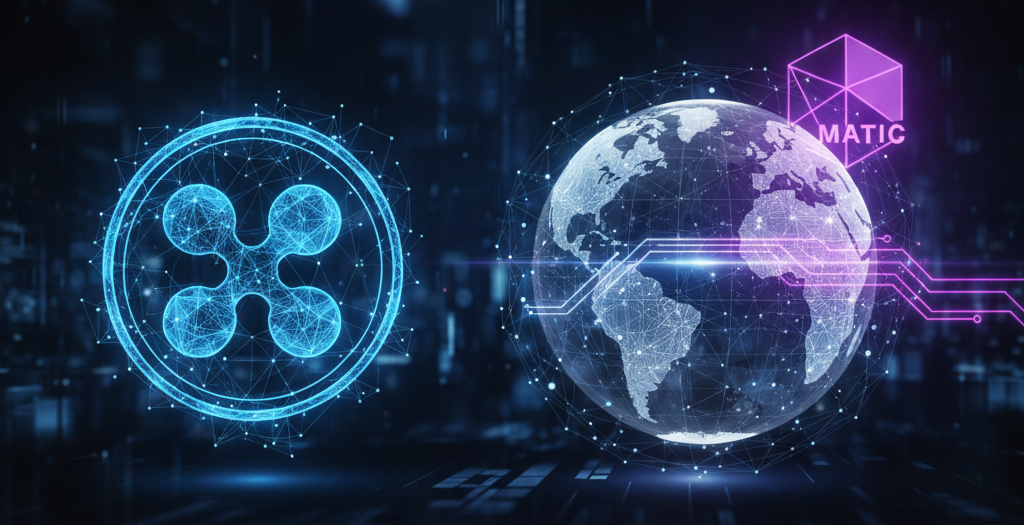
XRP and Polygon (formerly MATIC) are both prominent blockchain projects, but they target fundamentally different markets. XRP focuses on cross-border payments and institutional finance. Polygon focuses on scaling Ethereum and building a multi-chain ecosystem for decentralized applications.
Technology Overview
XRP Ledger
The XRPL is a purpose-built payment ledger using the Ripple Protocol Consensus Algorithm. It was designed from the ground up for fast, cheap value transfers — not general-purpose smart contracts (though EVM sidechain support is being added).
Polygon
Polygon is an Ethereum scaling ecosystem that includes multiple technologies: Polygon PoS (a proof-of-stake sidechain), Polygon zkEVM (a zero-knowledge rollup), and Polygon CDK (a toolkit for building custom chains). Polygon is fully EVM-compatible, meaning any Ethereum dApp can deploy on Polygon with minimal changes.
Security Models Compared
XRPL’s Federated Consensus
The XRP Ledger operates with 150+ validators in a unique federated Byzantine agreement system. Validators are run by universities, exchanges, and Ripple itself, with no mining or staking requirements. This model provides deterministic finality in seconds while consuming negligible energy (0.0079 kWh per transaction).
Polygon’s Hybrid Security
Polygon’s PoS chain relies on Ethereum for checkpointing while maintaining its own validator set of 100 active nodes. The zkEVM solution inherits Ethereum’s security via validity proofs. Polygon validators must stake POL tokens, with slashing penalties for misbehavior. This creates different trust assumptions than XRPL’s validator set.
Developer Activity & Network Growth
XRPL Development Trends
The XRP Ledger has seen steady growth in unique addresses (now exceeding 5 million) and daily transactions (averaging 1.2-1.8 million). Developer activity focuses on payment integrations, with major projects like the XLS-20 NFT standard and upcoming Hooks smart contract functionality. Over 80 financial institutions currently use XRP or the XRPL in production.
Polygon’s dApp Explosion
Polygon hosts over 53,000 dApps as of Q2 2024, with particularly strong growth in gaming (2,100+ games deployed) and socialFi applications. The network processes 3-4 million daily transactions, with TVL in DeFi protocols consistently above $1 billion. Polygon’s developer tools like the Supernets SDK have accelerated adoption.
Performance Comparison
| Metric | XRP (XRPL) | Polygon (PoS) |
|---|---|---|
| Finality | 3–5 seconds | ~2 seconds (PoS), varies (zkEVM) |
| TPS | 1,500+ | 7,000+ (PoS) |
| Average fee | ~$0.0002 | ~$0.01–0.05 |
| Smart contracts | Limited (Hooks, EVM sidechain coming) | Full EVM compatibility |
Interoperability Approaches
XRPL Bridges
The XRP Ledger has implemented cross-chain bridges through third-party solutions like Bifrost and Axelar. These enable XRP transfers to Ethereum, Cosmos, and other ecosystems. Ripple’s upcoming EVM sidechain will introduce native interoperability with Ethereum-based smart contracts while maintaining the XRPL’s core performance characteristics.
Polygon’s AggLayer
Polygon’s Aggregation Layer (AggLayer) provides unified liquidity and state synchronization across all Polygon chains. This architecture allows dApps to interact seamlessly between Polygon zkEVM, PoS, and future CDK chains. AggLayer processes over 200,000 cross-chain messages daily with sub-second latency.
Ecosystem and Use Cases
XRP excels in payments. Ripple’s enterprise partnerships, ODL corridors, and the XRPL’s native DEX and AMM create a focused ecosystem around financial infrastructure. The use cases are narrow but deep.
Polygon excels in DeFi and dApps. With full Ethereum compatibility, Polygon hosts thousands of decentralized applications including Aave, Uniswap (on Polygon), QuickSwap, and gaming platforms. Major brands like Nike, Starbucks, and Reddit have used Polygon for NFT and Web3 initiatives.
Enterprise Adoption
Both projects have enterprise traction, but in different ways:
- XRP/Ripple: Banks, payment providers, and financial institutions — focused on B2B payments infrastructure
- Polygon: Consumer brands, gaming companies, and DeFi protocols — focused on bringing Web3 to mass-market applications
Regulatory Posture
XRP’s Legal Clarity
Following Ripple’s partial legal victory against the SEC in 2023, XRP has clearer regulatory status in the U.S. than most cryptocurrencies. The court ruled that XRP is not inherently a security, though institutional sales remain under scrutiny. This positions XRP favorably for traditional finance adoption.
Polygon’s Compliance Strategy
Polygon operates primarily as an Ethereum scaling solution, inheriting some of Ethereum’s regulatory assumptions. The project has actively engaged with regulators through initiatives like the Polygon ID framework for compliant DeFi. However, as an L2 solution, it faces less direct regulatory pressure than base-layer protocols.
Tokenomics
| Metric | XRP | POL (formerly MATIC) |
|---|---|---|
| Max supply | 100 billion | 10 billion |
| Circulating supply | ~57 billion | ~9.3 billion |
| Inflation | None (deflationary via burns) | Low (staking emissions) |
| Staking | Not available natively | Yes (PoS validator staking) |
Network Upgrades Roadmap
XRPL 2024-2025
The XRP Ledger has several major upgrades planned, including Hooks for basic smart contract functionality (Q4 2024) and the EVM-compatible sidechain (Q1 2025). These developments will expand XRPL’s capabilities while maintaining its core payment efficiency. The community is also voting on XLS-38d for native cross-chain functionality.
Polygon 2.0
Polygon’s roadmap focuses on unified liquidity through AggLayer v2 and zk-powered L2 chains. The transition from MATIC to POL tokens is complete, with staking rewards now accruing in POL. Polygon plans to onboard 10+ new CDK chains in 2025, targeting sectors like institutional DeFi and RWAs.
Investment Considerations
- Choose XRP if you believe in the institutional payments thesis — banks adopting crypto for settlements, ODL volume growth, and Ripple’s regulatory moat
- Choose Polygon if you believe in Ethereum scaling and mass-market dApp adoption — gaming, DeFi, NFTs, and consumer Web3
The two projects have minimal competitive overlap, making them potentially complementary in a diversified crypto portfolio.
This article is for informational purposes only and does not constitute financial advice. Always do your own research before making investment decisions.